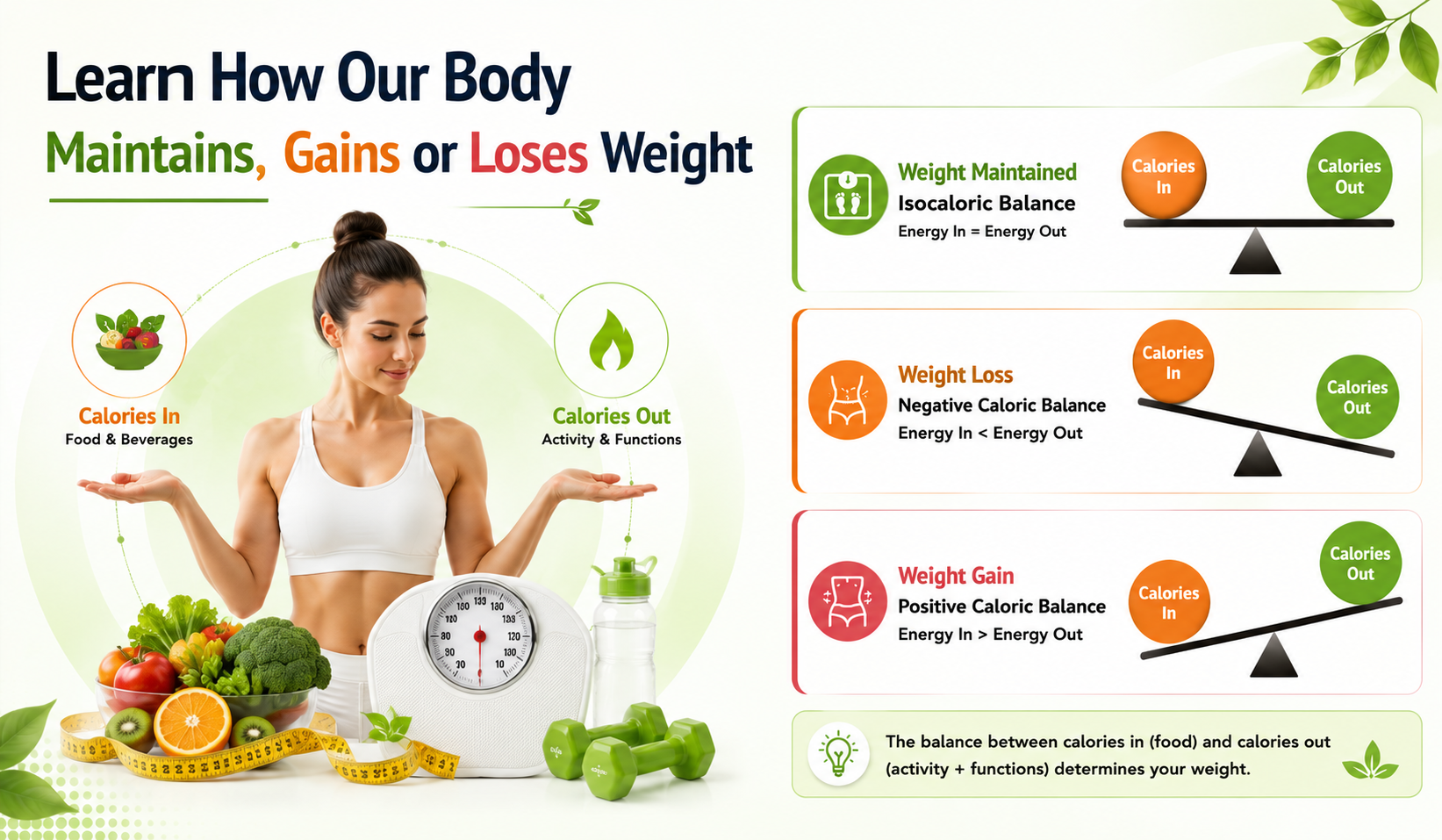
Learn How Our Body Maintains, Gains or Loses Weight
It might not be out of place to briefly see how our body maintains, gains or loses weight.
The food that we eat supplies us with energy which our body requires for its daily activities and functions. This energy is measured as Calories (or kilocalories). When we consume calories in excess of our daily needs, they are converted into fat and stored in our body for future use. When we eat fewer calories than we actually require, our body burns the stored fat to make up for the shortage, and the stored fat is lost. It is this storage or loss of fat which makes us gain or lose weight (respectively). When we eat exactly the same number of calories as we burn, our weight remains constant. When we consume more calories than we burn, our weight goes up. Conversely, when we eat fewer calories than we burn, we lose weight. This is the mechanism of weight control.
It takes about seven thousand Calories (i.e. kilocalories) to lose weight by one kg, and closer to nine thousand Calories to gain one kg.
Here, you should remember that our bodies do not have a dead exact weight like, say a table or a chair. We have constant variation in weight, even in the range of a kg or more. These are physiological variations and you should not worry about them. Your weight goes up after a meal and down after bowel movement. If you sit in one place for hours like in a long journey, or if you are constipated, or just before the menstrual cycle in ladies, you may gain a kg or more. Around ovulation, a day fourteen days prior to their next periods, many ladies gain two, three or more kg weight for a day or so and lose them as suddenly as they gain them. Thus your weight keeps varying throughout the day and months.
Most slimming programs insist that you must lose 150 grams every day, when your weight can easily go up and down by kg or more at different times throughout the day. Now you can easily see why this is an absolutely ridiculous demand!
Note
Read the article ‘Basics Of Nutrition’ and ‘Slimming Simply’ on this website. Get in touch with us through the ‘Contact Us’ page on this website.